

Somewhere in the United States right now, a credit card is being opened in a name that belongs to someone else. The FTC logged 406,110 of those cases in 2024 alone — the single largest type of identity theft Americans reported that year. And the damage keeps compounding: consumers reported $15.9 billion lost to fraud in 2025, up from $12.5 billion the year before.
On the other side of the counter, the legitimate customer gives up. Roughly seven in ten people abandon a financial-services signup before they finish. Not because they are fraudsters — because the process is slow, asks for too many documents, and bounces them from one screen to the next.
These are not two separate problems. They are the same problem seen from two angles: the friction that pushes good customers out is the same friction that gives fraudsters time and room to work. And the root cause is an onboarding architecture almost everyone inherited — identity in one step, fraud in another.
The onboarding paradox
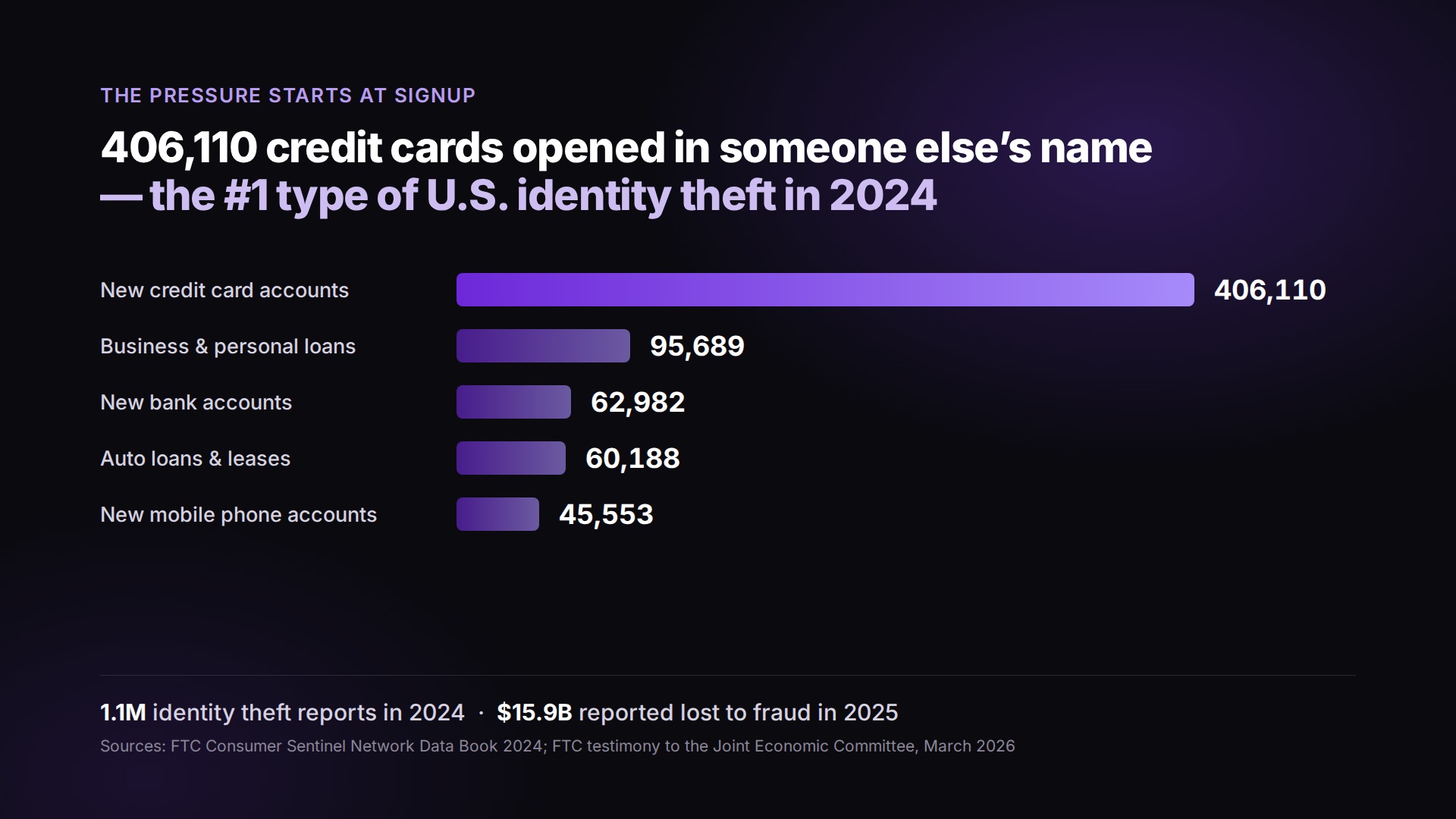
New credit cards lead by a wide margin, but the pattern runs through every product that opens an account online: personal and business loans, bank accounts, auto loans and leases, mobile phone lines. Insurance is catching up fast — identity theft reports tied to insurance rose 37% in 2024. Fraudsters don't pick an industry. They pick the easiest door.
And the easiest door is often the one designed to be "rigorous." The more steps, redirects, and manual reviews a flow has, the more time a fraudster gets to adjust — and the more reasons an honest applicant finds to close the tab.
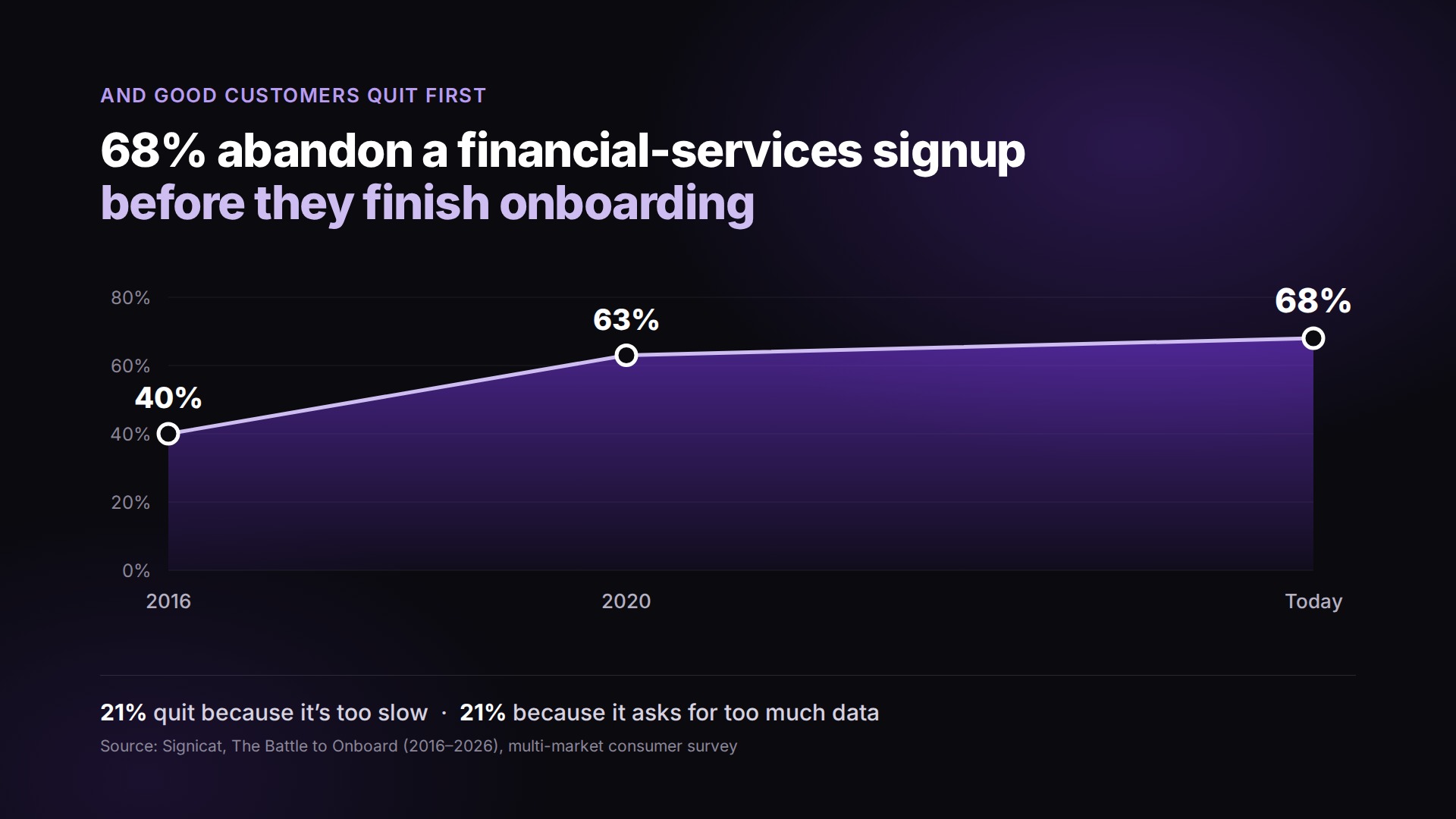
Signicat's long-running research tracks the curve: 40% abandonment in 2016, 63% in 2020, 68% today. Among those who quit, 21% blame speed and another 21% blame the amount of data requested. Customers aren't getting less patient. Onboarding is still treating every applicant as a suspect until proven otherwise.
Why splitting identity and fraud is the structural mistake
In most operations, the flow looks like this: one vendor checks the document and runs biometrics; another screens PEP and restricted lists; a third scores fraud risk; and an analyst stitches the pieces together hours — sometimes days — later.
Every seam carries a specific cost:
Two points of failure instead of one. Identity can pass while fraud fails, or the other way around. Who decides? Usually no one — the case lands in a review queue, and the queue is where conversion dies.
Every redirect is a drop-off. Each time an applicant leaves your environment — for a third-party page, a biometrics app, an emailed link — part of your funnel doesn't come back. On mobile, redirects are the single biggest cause of abandonment.
Latency is a fraud window. Between document capture and the final decision, the fraudster already knows whether the document passed. If fraud analysis runs afterward, they can retry with another synthetic identity before your systems connect the two attempts.
Scattered data is regulatory exposure. Selfie at one vendor, ID at another, SSN at a third. Every copy of personal data is exposure under the GLBA Safeguards Rule and a growing patchwork of state privacy laws such as the CCPA — and one more trail to reconstruct when an examiner asks how your Customer Identification Program reached a decision.
The practical result: you approve slowly the people you should approve fast, and you reject — or lose — the people you should have approved. The bar looks strict, but it's calibrated against the wrong customer.
One step, two answers
The principle is simple: the moment someone shows their ID and their face, the system should already answer both questions — who is this person? and is this person trying to defraud us? — before the screen moves on.
That's how SmartFlow is built. A single KYC funnel, embedded in your site, your app, or a chat conversation, that runs in sequence without ever leaving your context:
- Document reading — driver's license, state ID, or passport, with authenticity checks and data extraction.
- Liveness and deepfake detection — the selfie has to come from a real person, in front of the camera, right now.
- Face match between the selfie and the document photo.
- PEP and restricted-list screening in the same pass.
- Fraud signals — device, network patterns, identity reuse.
The outcome arrives by HMAC-signed webhook: approved, rejected, or review, with evidence attached. Zero redirects, under three minutes for the applicant to finish, and 100% of camera, liveness, and personal data isolated on Zarv's infrastructure — the Stripe Checkout model, applied to identity. Nothing sensitive touches your front end.
And because rules are configured per campaign, verification depth follows the value at risk: a prepaid phone plan doesn't need the same friction as an auto loan.
In practice, by industry
Insurance. At first notice of loss, SmartFlow confirms that the person filing is the policyholder — document, liveness, and face match in one step — before the claim moves forward. Claims filed under someone else's identity are stopped at intake, without adding a queue for legitimate policyholders. More in insurance solutions.
Lending and auto finance. Applicants complete KYC inside a web chat or over WhatsApp: they share their ID and a selfie in the conversation, and the identity and fraud decision comes back in the same channel within minutes. No app to download, no link to chase, no applicant lost halfway through. More in credit and lending solutions.
Car rental. At key handover, verification happens at the counter or on the renter's own phone. Identity confirmed, deepfakes ruled out, lists checked — and the car leaves with certainty about who is driving it. It's the same problem fleet risk management deals with across the whole rental, solved at the first point of contact.
Digital banks, buy now, pay later providers, wireless carriers, and retailers follow the same logic: wherever there's a digital signup, there's the same choice between a fragmented flow and a single one.
Conclusion
The industry spent a decade trying to reduce fraud by adding steps — and mostly succeeded at reducing conversion. The latest numbers show both curves rising together: more fraud, more abandonment.
The answer isn't one more step. It's one step that answers identity and fraud at the same instant, inside your own environment, with the right depth for the risk in play.
Explore SmartFlow and see the funnel running in your flow in minutes.
Sources: FTC, Consumer Sentinel Network Data Book 2024; FTC testimony before the Joint Economic Committee, March 2026; Signicat, The Battle to Onboard (2016–2026).