

Cybercrime losses reported to the FBI's Internet Crime Complaint Center reached $20.9 billion in 2025, up 26% from 2024. Stolen money has to land in an account before it moves on, and too often it lands in one of the money mule accounts criminals keep on hand. The latest Zarv ID update reads the network around each customer to find them.
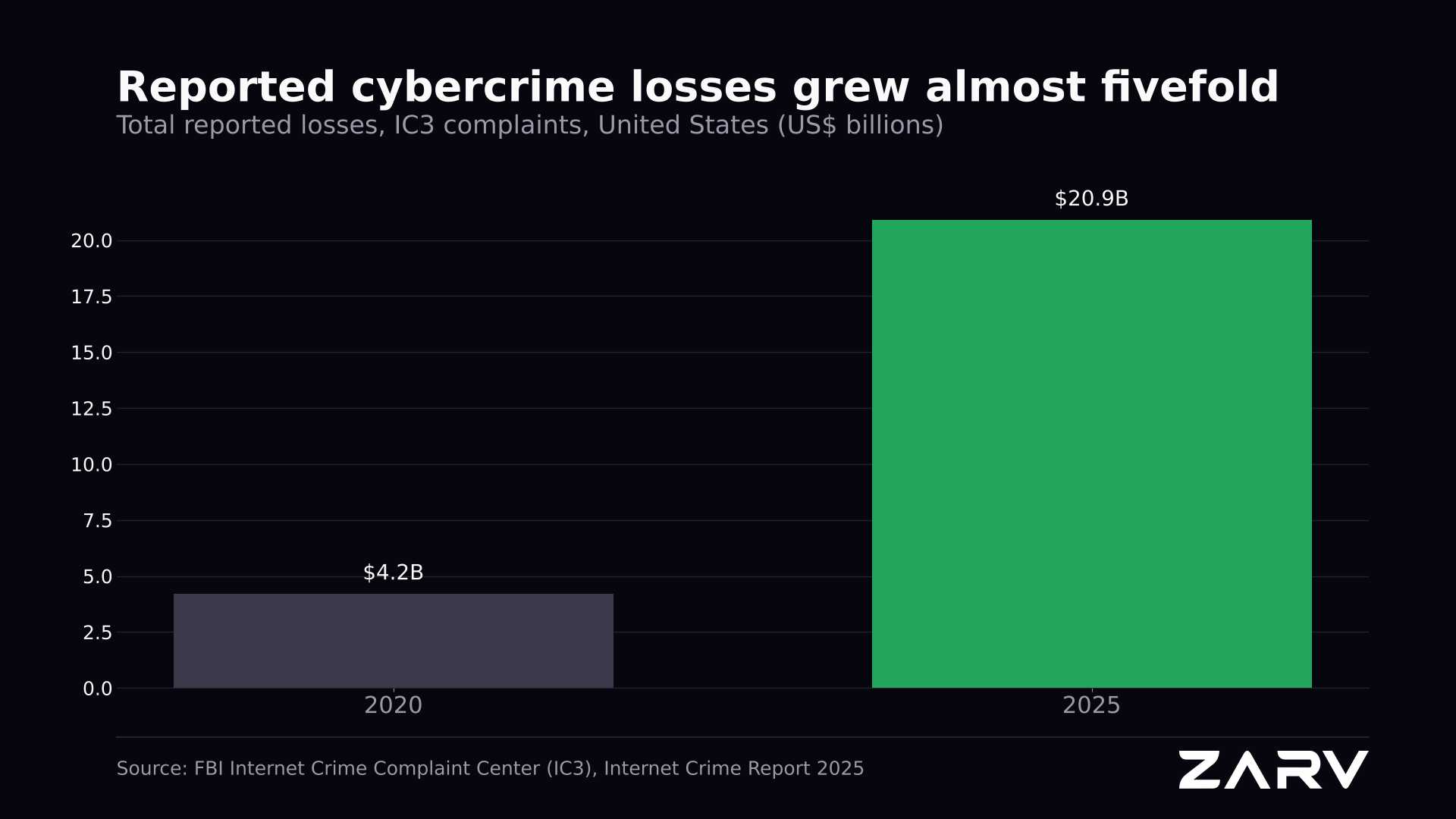
Reported cybercrime losses grew almost fivefold in five years. Source: FBI Internet Crime Complaint Center, Internet Crime Report 2025.
What is new in Zarv ID?
Four changes, all aimed at the same decision: approve, underwrite or price with less uncertainty.
- Network profile. Beyond the person or business you look up, Zarv ID reads the network around them, and the court-records layer now follows that network.
- Verification and enrichment profiles. Each operation chooses between a ready-made risk analysis and organized data only.
- Audit trail on every lookup. Access to personal data and every decision is logged, with who did it and when.
- Usage and billing in one place. Each lookup produces a single charge, and consumption is recorded centrally.
The sections below show what each one changes for the person making the call.
Why are money mule accounts a network problem, not a file problem?
The person lending their name is real, and usually has a clean file. That is why a money mule tends to clear a check that looks only at their own record: the signal is not there. It sits around them, in who else connects to that name, and through which businesses, addresses and contacts.
The same logic applies to a synthetic identity, built from real and invented data to pass verification. One file looks fine. The pattern across files does not.
How do you spot a money mule account?
A single record rarely shows it. The set does. The indicators usually look like patterns of connection, not attributes of a person:
- accounts with no apparent relationship that share contact details or addresses;
- thinly active businesses tied to the same names;
- links to people and businesses that have already appeared in fraud cases.
Each item alone can be innocent. Together they form a profile. That is why relationship graph analysis became part of the risk decision, as we showed in scammers disguised as good customers. Looking at a file once, at sign-up, is not enough. The network has to be read at the door and followed afterward.
What is the network profile in Zarv ID?
The network profile is a read of the whole set around the person or business you look up: who is connected, how much that set weighs on risk, and where each alert came from. Zarv ID already read that network. What is new is that court records now follow it.
Court records of partners and connected businesses enter the analysis, and the team sees where each alert came from without opening case after case. Raw dockets come with their own problems, which we covered in why court records break background check accuracy. Where a report feeds an employment, tenancy or credit decision, the Fair Credit Reporting Act's accuracy standard applies, so how those records are read matters as much as how many are pulled.
What does this change for insurers, lenders and rental companies?
Three illustrative situations, one logic:
- An insurer, underwriting an auto policy. The underwriter sees the applicant's network profile next to the risk band. A clean name tied to problematic connections stops passing unnoticed, and pricing stops depending on the file alone.
- An auto lender, on a new-business application. The analysis considers the owners and the businesses in the same group, including their court records. The analyst declines with a clear reason or approves with more confidence.
- A rental company, onboarding a new renter. The team decides when to request the full analysis and when the network data is enough, depending on the channel and the customer profile.
The logic holds for any operation that extends credit, coverage or possession of an asset before knowing who is on the other side.
What is the difference between a verification profile and an enrichment profile?
Not every operation wants the same thing from Zarv ID. An insurer pricing a policy wants a ready recommendation. A collections or investigations team wants the network data organized for its own workflow.
The verification profile delivers the full risk analysis: behavioral risk score, risk band and alerts, ready to support the decision. The enrichment profile delivers only the organized data, with no score and no recommendation, for teams that prefer to decide inside their own flow.
The choice is made per profile, not per account. The same customer can use both, each in a different process. Each profile also defines which query layers run, such as the court-records analysis across the network, so the customer controls what it looks up in each flow and, with it, what it pays.
How does the audit trail help compliance and legal?
Every access to personal data and every Zarv ID decision is recorded: who looked up what, and when. For compliance, that shortens the response to an audit or a consumer request. For legal, it is the record that a decision had a basis and an owner.
It lines up with the rules that govern personal data in the United States, from FCRA permissible-purpose requirements to state privacy laws such as CCPA and CPRA, which reward being able to show what you did with the data and why. A log does not replace a lawful basis or data minimization, but it is the piece that lets you prove, later, that the process was followed.
What changes in billing?
Zarv ID usage is now recorded in a single place, and each lookup produces a single charge. For finance, that makes it easier to match what was queried with what was billed. The commercial model stays the same: usage-based, per API query, with no minimum. See pricing.
Where does Zarv fit in this risk journey?
At the verification stage, Zarv ID delivers the decision to approve, underwrite or price with the connected network already taken into account. For credit and insurance, that means fewer good customers declined and fewer surprises after signing. Because mule risk also appears after onboarding, Zarv Signal follows the contract and flags when risk changes.
Frequently asked questions
What is a money mule?
A money mule is a person who receives or moves money for someone else, knowingly or not, through an account in their own name. The mule appears as the account holder, while the real beneficiary stays outside the file a company looks up, which is why the network around the account matters.
What is a relationship network profile?
It is the read of the set of people, businesses, addresses and contacts connected to the person or business you look up, not just their own record. It shows who is connected, how much that set weighs on risk and where each alert came from, so the decision reflects what surrounds the file.
What is the difference between a verification profile and an enrichment profile?
A verification profile delivers the finished risk analysis, with score, risk band and alerts, to support the decision. An enrichment profile delivers only organized data, with no score, for teams that decide inside their own flow. The same customer can use both, each in a different process of the operation.
Does the audit trail help with compliance?
It helps show who accessed personal data and when, which makes it easier to answer audits and consumer requests. Privacy and consumer-reporting rules ask for much more than a log, including a lawful basis and data minimization, but the trail is a central piece of accountability.
How is Zarv ID billed?
Billing is per API query, with no minimum: you pay for what you look up, as described on the pricing page. Each lookup produces a single charge, and consumption is recorded centrally, which makes it easier to follow usage and reconcile the invoice with finance.
Conclusion
The updates point to one principle: a risk decision has to see the network around whoever is being checked, and leave a record of how it was made. See Zarv ID running in your workflow.
Sources: FBI Internet Crime Complaint Center (IC3), Internet Crime Report 2025 (2026).